 Home
Home
Powerco battery gigafactory in Valencia to start production in 2026


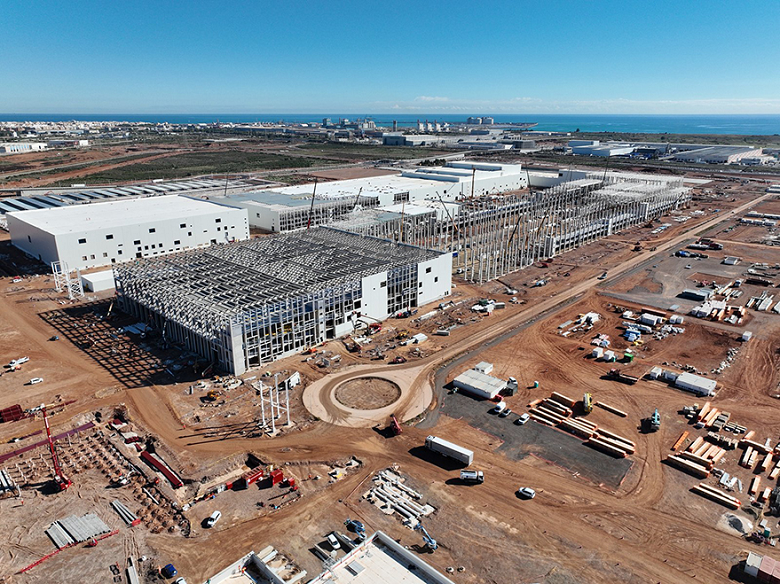
Around 1,400 people are working on the construction of the plant and a further 500 new jobs are expected next year.
Construction work on Valencia’s battery gigafactory is progressing well. 11 industrial buildings and the structure of the first production unit have been completed in just one year. This building, together with the entrance and exit buildings, will be completed before Christmas, and, work is already under way currently on the installation of the clean and dry rooms.
As explained by PowerCo Spain’s Chief Financial Officer, Javier Rivera, the company’s immediate priority is “to complete the civil engineering work for the first production unit, continue with the installation of the clean and dry rooms and make progress with the construction of the second unit. From the first quarter of 2026, installation of all the production equipment will begin so that the gigafactory is ready to produce its first cells at the end of September.”
Employment generation
Around 1,400 people are working on the construction of the gigafactory. These include the engineering and construction teams and staff from the Volkswagen Group subsidiary. PowerCo already has a team of 300people, in fact, to which the first plant operators will be added from January 2026. The company plans to hire around 500 employees over the coming year, and will provide them with specific training in the gigafactory’s production process.
When it begins operating in September 2026, the plant will become a key player in the energy transition thanks to the manufacture of battery cells, essential for the electrification of vehicles. It will be able to produce cells with different chemicals, such as LFP (lithium iron phosphate) and NMC (lithium nickel manganese cobalt oxide). It will start with the former, aimed at meeting the current demand for Volkswagen Group models and, in the future, it also intends to incorporate sodium and solid-state cells.
Clean and dry rooms
The phase that the construction of the plant has now entered is particularly important. As Rivera explained, the production process takes place in clean and dry rooms, ensuring the necessary conditions regarding temperature, humidity and absence of particles in order to manufacture cells with full guarantees, “This is a key milestone in our project, marking the home stretch towards the start of production at the end of September next year.”
A total of 17 clean rooms will be installed, covering 57,000 square metres in total, the equivalent of eight football pitches. Some of them will also be dry rooms, because the active material in the cathode and the electrolytes react aggressively with water. They will be equipped with air purification systems and large-scale dehumidifiers (DHUs) in the initial stages of production to completely remove humidity and keep it constantly below 1%.
According to Rivera, this project “is the spearhead of the transformation of the Spanish automotive industry and helps to consolidate the electric vehicle ecosystem in Europe. Batteries are a key technology in the energy transition, and the location of their production and value chain is a strategic element for competitiveness, resilience and industrial independence.”
Photo: PowerCo