
 Home
Spain reaffirms its role as an investment bridge to Latin America


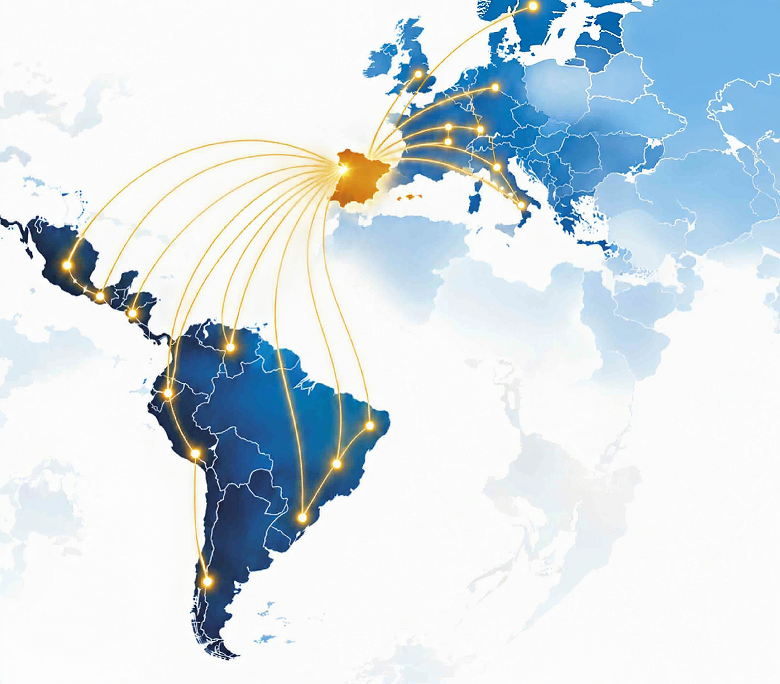
744 foreign companies use Spain as a platform to invest in the region, where they control 1,081 subsidiaries.
Spain is far more than a bridge for investment flows into and out of Latin America; it is a springboard and a strategic hub from which capital gains momentum in both directions. That is how our country is described in the report “El uso de trampolines en la inversión extranjera del mundo hacia América Latina: el papel de España” (The use of springboards for foreign investment from around the world into Latin America: Spain’s role), produced by the Business Council Alliance for Ibero-America (Ceapi) in collaboration with the Complutense University of Madrid (UCM).
Specifically, Spain ranks first worldwide and is the leading direct springboard for investment in 11 of the 19 Latin American countries analysed in this study, accounting for more than 40% of intermediated ownership chains in some of them. In total, 1,030 immediate springboards have been identified, accounting for 16.7% of the global total, alongside 889 direct springboards (14.4%). The direct springboard refers to the first country used by the global parent company to structure its international ownership chain, while the immediate springboard is the last economy before reaching its Latin American destination.
A platform for investment
The analysis reveals that 744 foreign companies use Spain as a platform to invest in Latin America and control a total of 1,081 subsidiaries, around 1.5 per parent company. Among foreign countries, the United States makes the greatest use of the Spanish economy to invest in the region. In total, it does so through 125 companies, representing 16.8% of the total, which manage 157 subsidiaries.
And while Spain is the leading springboard, Europe is the main source of investment in Latin America, accounting for 38.6% of the global parent companies investing in the region. This is why 60% of the companies that use our country as a springboard are European, while Canada and the United States account for between 18% and 21%. Both North American countries also frequently use Spain as a European base to channel their presence in Latin America. The data also reveal growing interest from Asia and the Middle East.
A unique position as a bridge economy
These findings highlight Spain’s appeal as an investment destination. According to Professor of Applied Economics Isabel Álvarez, the country has consolidated “a unique position as a bridge economy between Europe and Latin America, and is the leading springboard for investment flowing into the region from the rest of the world”.
Indeed, Álvarez adds: “This confirms that the Spanish economy acts as a hub or strategic node channelling European, North American, Asian and even Latin American investment into Latin America, helping to strengthen the role of multi-Ibero-American companies in the integration of the Ibero-American region.”
One of the leading recipients of Latin American foreign direct investment
The report also reveals that Spain not only leads European foreign direct investment (FDI) in Latin America, with a stock of nearly $229 billion in 2024, but is also one of the leading recipients of Latin American FDI in Europe.
Another key finding is that Spain is not merely a transit point for capital as a significant proportion of the companies that channel their investments through our country also carry out productive activities here.
Overcoming location disadvantages
The springboard concept describes how companies use third markets to overcome location disadvantages while gaining access to knowledge, technology and more favourable institutional frameworks. In Spain’s case, it is not only economic factors that matter but also factors such as cultural affinity, institutional stability, accumulated business knowledge and its ability to connect Europe and Latin America.
The study analysed more than 54 million microdata records to reconstruct the ownership chains of companies operating in Latin America, identify the ultimate origin of their investments and determine which investments are channelled through Spain.
Photo: Ceapi