 Home
Home
Subsea Barcelona-Marseille hydrogen pipeline enters new phase


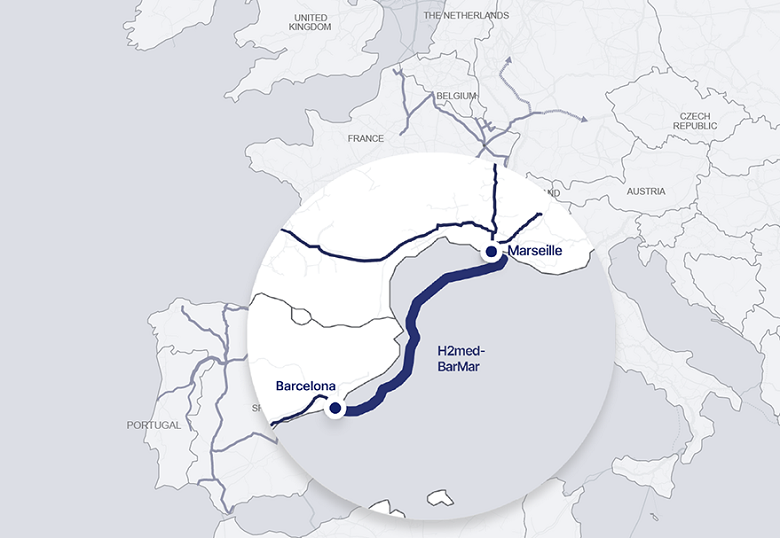
The international H2med consortium aims to bring BarMar into operation in 2032.
The H2med project is entering a new phase in its development, bringing it closer to becoming the European Union’s first major green hydrogen corridor. The consortium, spearheaded by Spanish operator Enagás alongside Portugal’s REN, France’s NaTran (formerly GRTgaz) and Teréga, and Germany’s OGE, has announced the start of the Front-End Engineering and Design (FEED) phase for the BarMar subsea hydrogen pipeline, which will connect Barcelona with Marseille, France.
This European initiative aims to connect the Iberian Peninsula’s hydrogen transport network with north-western Europe, providing the continent with an affordable supply of green hydrogen. The next step will be to award the contracts for the FEED and a detailed marine survey, providing partners and investors with the technical basis needed to make the final investment decision.
Crucial step towards finalising design
The launch of BarMar’s detailed engineering phase follows the successful completion of the preliminary engineering studies (pre-FEED) and marks a crucial step towards finalising the design of this subsea infrastructure, which is vital to Europe’s decarbonisation and energy independence.
BarMar’s pre-FEED phase has confirmed the project’s technical feasibility and helped establish the design basis for the hydrogen pipeline and its associated compression station, which is planned for installation next to Enagás’s regasification plant in Barcelona. A preliminary route for the corridor has in addition been defined based on the initial findings of the environmental impact assessment, which is still under way.
This pre-FEED phase, which included marine survey campaigns, has been funded through contributions from the five European partners and support from the Connecting Europe Facility (CEF), which awarded it more than €28 million in January 2025. The project can now move from the conceptual design to the final technical architecture.
Preparing for construction
The process now under way will confirm the final design and route of the BarMar hydrogen pipeline. The layout of the compression station will also be finalised, documentation will be prepared to secure the relevant permits, and the technical specifications required to prepare for construction and procure materials will be defined.
In early July, the meeting of the high-level group on southwest Europe not only coordinated the strategic deployment of this energy interconnection, but also highlighted the momentum and institutional support behind H2med. The meeting brought together energy ministers from Portugal, Spain and France, the European Commissioner for Energy, regulators and the operators of the H2med corridor, with Germany also taking part for the first time.
BarMar CEO Francisco de la Flor described this new phase as “a key step towards achieving Europe’s decarbonisation goals”, and announced that the corridor, “designated as a Project of Common Interest (PCI) and as an Energy Highway by the European Commission, aims to become operational in 2032”.
Photo: H2med