 Home
Home


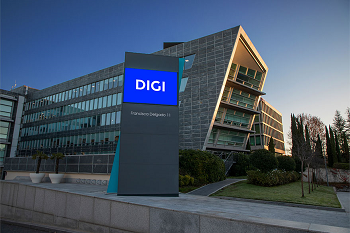
Digi has invested more than €1.5 billion in its Spanish fibre-optic network and plans to invest another €2 billion.
The Digi Communications group was founded more than 30 years ago in Romania in the telecommunications sector, with a significant presence in the pay-TV and broadband services market. With a presence in Portugal, Italy and Belgium, its main markets are Romania and Spain, where it operates an extensive and advanced fibre optic network.
Digi arrived in Spain in 2008 and has since grown to reach 9.6 million customers at the end of the first half of the year. The company offers mobile and fixed telephony, broadband and television services. Its fibre optic network (Fibra Smart), recognised as the fastest in Spain by the Ookla Speedtest Awards since 2021, reaches more than 12.5 million households.
Why did you decide to establish yourselves in Spain in 2008?
Digi, as a subsidiary of the Digi Communications group, shares the goal of offering quality services at competitive prices and with advanced technology, or, in other words, providing quality connectivity within everyone's reach. This same goal inspires and guides investments in all the countries where the group operates. In 2008, we started in Spain as a niche operator, focused on offering mobile phone services to the Romanian community living in Spain, which was very large. Subsequently, we evolved with a range of mobile services open to the entire Spanish market. In 2017, we understood that the market was changing and moving towards a convergence of all communications services (mobile and fixed), and at Digi we accepted the challenge, transforming ourselves into a convergent operator through investment in fibre-optic networks and focusing on the residential market. Since 2017, we have invested more than £1.5 billion in the deployment of a new-generation fibre-optic network throughout the country. It is this investment that has to date enabled us to fulfil our goal of offering connectivity that everyone can access at very competitive prices: we have achieved 12.5 million households and hope to become, in the short term, the third largest operator by number of customers in fixed wireless internet access services.
What have been your greatest achievements?
We were the first operator in Spain to offer a speed of ten gigabits per second to our customers with our Fibra Pro-Digi service, something which significantly improves the browsing experience, when streaming videos, for example, as well as in video conferences and when teleworking. It is currently available in 93% of the country. The company has more than 10,000 employees in Spain, making it the second largest Spanish operator in terms of the number of employees in the industry. We are now implementing our €2-billion investment plan. Our goal is to reach 20 million households with fibre coverage by 2030, as well as deploying 5,000 antennas to provide mobile coverage to our customers.
Spain is a highly competitive market, with three major operators and many other competitors. What sets Digi apart from all of these?
Digi's industrial project is a model of proven strength and solvency, essentially based on four pillars: investment in networks, quality offerings at competitive prices, vertical integration, and all of this supported by a stable, secure and predictable regulatory environment. However, the feature that especially sets us apart is that our business model is based on the generation of stable, quality employment aimed at covering all the activities that make up the value chain. It is this model of activity integration that results in high operational efficiencies, whilst also allowing us to exercise exhaustive control over the quality of end-to-end services and create value through the creation of local employment in all the Spanish provinces where we operate.
How important is Spain in the company's strategy?
Spain is the second most important market for the Digi Communications group and the one with the highest growth. Digi's investment level stands at over 40% of EBITDA, which shows that, as a company, we are confident of the strength of the Spanish economy to make investments with long-term objectives.
Unlike other small operators, you are rolling out your own fibre-optic and mobile phone antenna network. What is the motivation behind this commitment and what are the investment figures?
For Digi, the regulation allowing access to Telefónica-owned ducts and poles (MARCo) in Spain has been key to supporting our investments, by focusing them on the installation of a technologically advanced network, and without facing the difficulties, and often impossibilities, of having to replicate existing ducts and poles. There is no doubt that this regulation has made it possible for Digi and other operators to roll out networks, making Spain a benchmark and leader in fixed network deployment and coverage. Having a stable and predictable regulatory framework clearly encourages investment that benefits Spanish society as a whole. Since 2017, we have invested more than €1.5 billion in the deployment of a new-generation fibre-optic network, 70 times more than we invested in the previous eight years. Our investment forecasts for the period 2024-2030 amount to €2 billion. This investment would be used to complete our FTTH network rollout, amounting to 20 million homes with Fibra Smart even before the end of that period, and it would also contribute to the installation of mobile antennas with Digi coverage, with 5,000 antennas forecast in the next three years and a target of 10,000 in the future.
How have you gained almost 10 million customers?
Digi's recognition as a telecommunications operator and its positioning among our customers has been gradual, the result of a combination of strategies, but mostly through the most basic one, which is recommendations by those customers who, satisfied with our service, are the first to recommend us to family and friends. Furthermore, since we began rolling out our own fibre network, many customers have also noticed the increasing presence of the vans used by our deployment and installation teams, something which has generated greater awareness and visibility among the public. We also run advertising campaigns through various media outlets and for several years now we have had a strong presence in the areas where we deploy our fibre network, by sponsoring local football teams. Through these sponsorships, we reach out to fans in the places where we operate, and we see this support for their teams as a way of repaying the trust they have placed in Digi by subscribing to our services. We also have our own network of stores (more than 60 throughout the country), stands in major shopping centres and more than 4,000 distributors, which also play an important role in positioning Digi as a leading operator for customers.
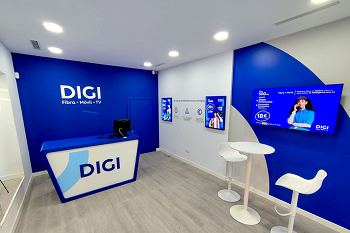
You are currently rolling out your own network of stores. Will this initiative improve customer acquisition?
We are opening our own stores with the aim of being closer to our customers and being able to respond to their queries in person. Many of the improvements we implement at Digi are due to requests from our customers, and this was a need they had conveyed to us. That is why we began opening our own stores in February 2023.
Why have you decided to have your own staff?
As I mentioned earlier, creating our own jobs responds to the need to meet the demand for employees that arises as a result of implementing a vertical integration model, which is one of the strategic pillars of Digi's project in Spain. We carry out all activities in the value chain with our own staff, which means that salespeople, customer service representatives, installers, and deployment technicians are all hired directly by Digi. We are currently the second-largest Spanish operator in terms of the number of employees. Over the last eight years, we have created more than 9,400 jobs as a result of our vertical integration strategy, thereby allowing us to have comprehensive control over the quality of our service and also over costs, all to the benefit of our customers. We currently have more than 10,000 directly hired employees.
Photos: Digi