 Home
Home
International agreement to build Granada particle accelerator


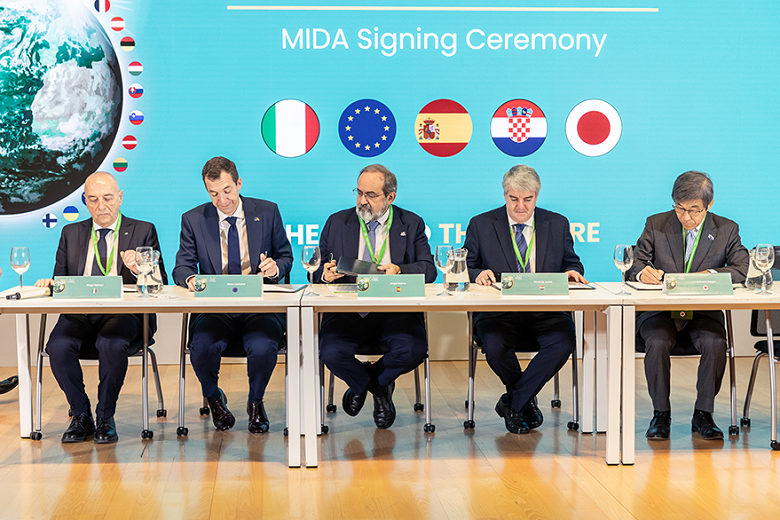
Fusion for Energy signs agreement consolidating its participation in the initiative.
Fusion for Energy (F4E), the organization that manages the European Union's contribution to ITER—the largest scientific experiment to achieve fusion energy—has signed an agreement that consolidates its participation in the particle accelerator in Escúzar (Granada). The multilateral international Dones agreement (Mida, by its English acronym) has also been signed by the Ifmif-Dones Spain consortium and by the INFN (Italy), QST (Japan), and Ruđer Bošković Institute (Croatia) R&D&I centres.
The agreement consolidates international collaboration to develop fusion energy at the Escúzar particle accelerator (Granada) and lays the foundations for the construction in Granada of Ifmif-Dones, a facility where materials for future fusion reactors will be tested. This energy source is considered clean, safe, sustainable, and virtually unlimited, and is comparable to that produced at the centre of the sun and stars.
Investment and advanced technologies
The construction and commissioning of Ifmif-Dones will mobilize investments from all signatory parties. The EU will contribute 25% of the total through F4E, representing an investment of €202 million. Its contribution will also include advanced technologies such as the particle accelerator (based on the LIPAc prototype). Spain will be the main contributor, covering 55% of the costs, alongside Italy (8%), Japan (5.1%), and Croatia (5%).
This agreement also establishes a comprehensive framework for decision-making, resource allocation, sound management, and transparent governance in the Dones program. In their participation, the signatories have committed to working in a coordinated manner to accelerate the development of critical fusion technologies.
Leadership role
Eva Ortega, Secretary General for Research at the Ministry of Science, Innovation, and Universities, explained that with this agreement “Spain is taking on a leadership role in fusion research in Europe and worldwide,” adding that our country “is ready to take on the challenge and is firmly committed to achieving it with all the partners in this agreement.”
The signatories to the agreement (pictured, from left) were the Vice President of INFN (Italy), Diego Bettoni; the Director of Fusion for Energy (F4E), Marc Lachaise; the director of Ifmif-Dones Spain, Ángel Ibarra; the director of the Ruđer Bošković Institute (Croatia), David M. Smith; and the president of QST (Japan), Koyasu Shigeo.
A new energy paradigm
For Ángel Ibarra, this agreement is “the culmination of years of collaboration, turning vision into reality. Spain's 55% commitment reflects its confidence in science and global partnerships. With construction set to begin soon, we are building hope and a new energy paradigm for future generations.”
Lachaise, for his part, stated that the agreement “expresses our commitment to continue exploring the potential of fusion together to provide clean, safe, and sustainable energy for future generations. Fusion for Energy will support Dones in this mission by contributing its knowledge to carry out part of the project and offering its extensive experience in international fusion projects.”
According to Smith, the agreement “demonstrates the power of international cooperation to accelerate fusion research,” while Shigeo said that QST will promote the Dones program in cooperation with the relevant parties, and Bettoni spoke of “a crucial milestone for the development of fusion energy.”
Photo: Ifmif-Dones