
 Home
Home
Spain bolsters business appeal with strong results in new World Bank Group Subnational Business Ready report


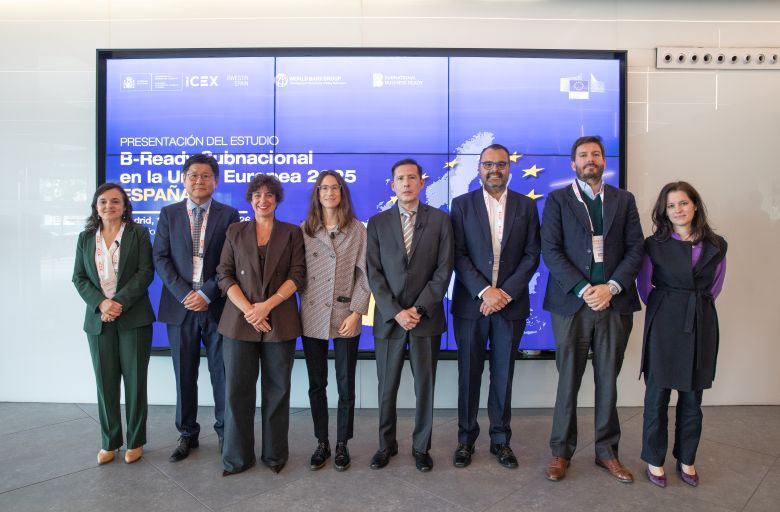
ICEX, together with the World Bank Group, has presented an analysis of the business environment in 17 cities in Spain.
· The report highlights the strength of Spain’s regulatory framework and its progress in digitalisation
· The cities analysed show strong results in the five areas assessed: business establishment, business location, public services, dispute resolution and business insolvency


ICEX, in collaboration with the World Bank Group, presented the Subnational Business Ready 2025: Spain report today, an analysis of the business environment in 17 cities - the most populous in each autonomous community – and offering a representative picture of the country as a whole. The report follows the Business Ready (B-READY) methodology, which provides a quantitative assessment of the global business and investment climate.
The study, prepared by the World Bank Group and funded by the European Commission, assesses the business environment regionally throughout a company’s life cycle, from its establishment through to potential insolvency. It forms part of an initiative rolled out in several European countries and now extended to Spain.
The presentation featured the participation of the Director of the World Bank Group’s Policy Indicators Group, Norman V. Loayza, who presented the report’s main findings and noted that “Spain has a solid, consistent regulatory framework. However, its practical implementation still leaves room for improvement at local level. The lack of administrative interoperability, the high tax burden in certain cities and the need to strengthen the trained staff required to handle the volume of cases create disparities from city to city in the speed with which businesses receive services.”
The Secretary of State for Trade, Amparo López Senovilla, has for her part stressed that “the report confirms that Spain is making steady progress in modernisation, digitalisation and improving the regulatory environment, key factors in strengthening the competitiveness of our companies and continuing to attract international investment”. In this regard, she highlighted that “those advances are already producing tangible results. In a particularly complex and uncertain international context, Spain once again broke export records in 2025 and cemented its position as one of the world’s leading destinations for productive, job-creating investment”.
A robust and consistent business environment
The report reveals that, overall, Spanish cities overall perform strongly across the five areas analysed: business establishment, business location, basic public services, dispute resolution and insolvency. The document notes that “over the past decade, Spain has promoted a programme of reforms aimed at business development, focused on digitalisation, transparency and efficiency”.
Among the key findings, the area of basic public services - electricity, water and the internet- stands out in particular, achieving the highest score of all the areas analysed, with an average of 87.3 points out of 100. This result reflects the quality of the regulatory framework and the country’s highly developed infrastructure and services.
The area of business establishment also shows a high degree of consistency across cities, driven by reforms such as the “Create and Grow” Act and the consolidation of the CIRCE one-stop shop, which have strengthened digitalisation and simplified company incorporation processes.
By contrast, the report identifies business location as the main area for improvement, particularly with regard to building permits and administrative procedures, where significant differences persist between regions, and with differences of up to nearly ten points between the best- and worst-performing cities. These variations are also reflected in the processing times for building permits, which range from 128 to 553 days, highlighting a high degree of inconsistency in local administrative efficiency.
One of the study’s main conclusions is that city size does not determine business performance. Large cities, such as Barcelona and Madrid, medium-sized cities, such as Valladolid and Pamplona, and smaller towns, such as Logroño, achieve strong results in several areas. The study also concludes that cities such as Bilbao, Pamplona, Seville and Vigo show relatively strong performance in most of the areas analysed.
Factors such as institutional efficiency and the level of digitalisation are by contrast decisive. In this respect, Spain stands out for significant progress in the digital incorporation of companies, digital connectivity and the modernisation of the judicial system, which have helped to improve the experience of companies in their day-to-day operations.
Perceived barriers for companies
The analysis is complemented by information from the World Bank Enterprise Surveys, which reflects the private sector’s perspective. According to these results, the regulatory aspects assessed in the report are not among the main constraints for companies operating in Spain.
The main barriers identified are the shortage of skilled labour (35%), followed by labour regulation (18%) and the tax burden (16%).
A tool to continue improving the business climate
The presentation brought together representatives from the Ministry of Economy, Trade and Enterprise, the European Commission and the World Bank Group, as well as foreign companies present in Spain, who shared their experience in the Spanish market.
For ICEX, this report is a strategic tool for continuing to improve the business climate and strengthening Spain’s ability to attract foreign investment.
“Having a rigorous diagnosis that is internationally comparable is key to pinpointing areas for improvement and continuing to strengthen Spain’s competitiveness,” said ICEX’s Chief Executive Officer, Elisa Carbonell.
The Subnational Business Ready report is part of an initiative that will continue to expand to other European Union countries over the coming years.